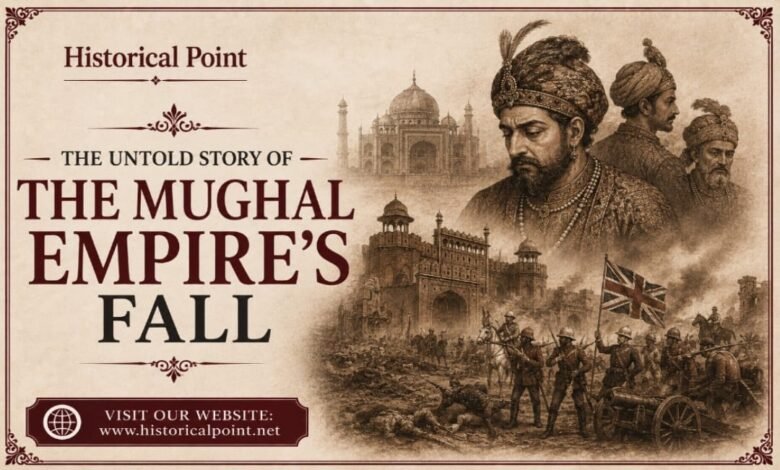
The Mughal Empire was one of the most powerful empires in South Asian history. Founded by Babur in 1526, it ruled large parts of the Indian subcontinent for more than three centuries. The Mughals left behind magnificent architecture, rich cultural traditions, and an important political legacy.
But how did such a powerful empire collapse? The fall of the Mughal Empire was not caused by one event. Political instability, weak rulers, regional revolts, economic problems, military challenges, and the rise of British power gradually weakened the empire.
The Mughal Empire at Its Peak
The Mughal Empire expanded rapidly under rulers such as Akbar the Great, Jahangir, Shah Jahan, and Aurangzeb.
Akbar developed a strong administrative system and expanded Mughal territory. Shah Jahan became famous for magnificent architecture, particularly the Taj Mahal.
Under Aurangzeb, the empire reached its greatest territorial extent. However, his long military campaigns placed considerable pressure on the empire’s finances and administration.
The Death of Aurangzeb
The death of Aurangzeb in 1707 was a major turning point in Mughal history.
After his death, several weaker emperors struggled to control the enormous empire. Powerful nobles and provincial governors began gaining more independence, while succession disputes weakened the central government.
Regions such as Bengal, Hyderabad, and Awadh gradually became increasingly autonomous.
Rise of Regional Powers
As Mughal authority declined, powerful regional groups challenged imperial control.
The Marathas became a major military and political force, while the Sikhs, Jats, Rajputs, and other regional powers also increased their influence.
The Mughal government struggled to maintain control over its distant territories, causing the empire to become increasingly fragmented.
Economic and Military Problems
Maintaining a huge empire required enormous financial resources. Years of warfare and declining revenue weakened the imperial treasury.
The Mughal military also became less effective compared with the armies of emerging regional powers and European forces.
Internal corruption, political rivalries, and competition among nobles further weakened the central administration.
Nader Shah’s Invasion
A major blow came in 1739, when Persian ruler Nader Shah invaded India.
Mughal forces were defeated at the Battle of Karnal, after which Nader Shah entered Delhi and took enormous wealth from the city.
The invasion exposed the weakness of the Mughal government and encouraged other powers to challenge the declining empire.
The Rise of the British East India Company
While the Mughals were losing power, the British East India Company was becoming increasingly influential.
The company’s victory at the Battle of Plassey in 1757 greatly increased British power in Bengal. Over time, the British expanded their political and military control across large parts of India.
The Mughal emperor continued to exist, but his actual political authority became increasingly limited.
The Last Mughal Emperor
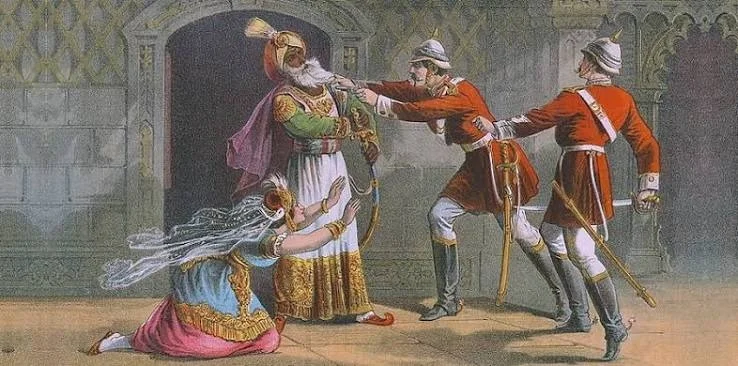
Bahadur Shah II, also known as Bahadur Shah Zafar, was the final Mughal emperor.
During the Indian Rebellion of 1857, he became a symbolic leader of the uprising against British rule.
After the rebellion failed, the British removed him from the throne and exiled him to Rangoon. He died there in 1862.
The British government formally ended the Mughal dynasty following the rebellion.
Why Did the Mughal Empire Fall?
The decline of the Mughal Empire resulted from several connected factors:
- Weak rulers after Aurangzeb
- Succession conflicts
- Regional revolts and independence
- Economic difficulties
- Military weakness
- Persian and Afghan invasions
- Expansion of the British East India Company
The empire therefore did not collapse overnight. Its decline happened gradually over more than a century.
Legacy of the Mughal Empire
Although the Mughal Empire disappeared politically, its cultural influence remains strong.
The Mughals left remarkable monuments such as the Taj Mahal, Red Fort, and Jama Masjid. They also influenced architecture, art, literature, cuisine, and administration across South Asia.
The story of the Mughal Empire is ultimately both a story of extraordinary power and gradual decline.
Conclusion
The fall of the Mughal Empire was caused by a combination of political instability, economic problems, military challenges, regional resistance, foreign invasions, and British expansion.
By 1857, the Mughal dynasty had reached its final chapter. Yet its cultural and architectural legacy continues to make it one of the most important empires in South Asian and world history.