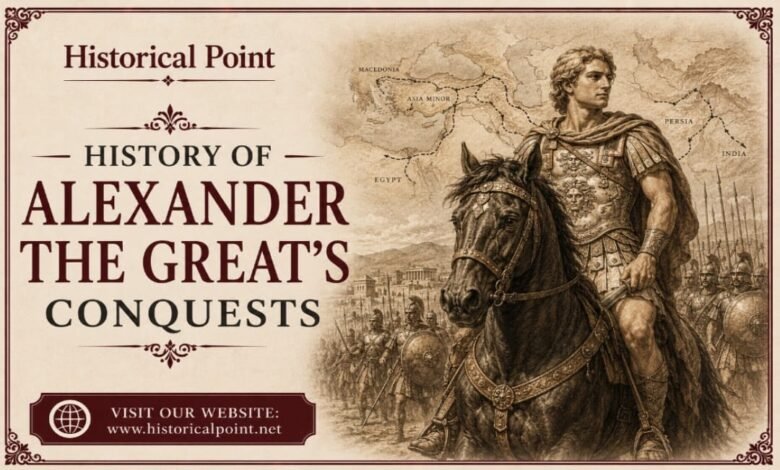
Alexander the Great is one of the most famous military leaders in world history. In just over a decade, he conquered vast territories stretching from Greece and Egypt to Persia, Central Asia, and northern India. His extraordinary military campaigns destroyed the powerful Persian Empire and created one of the largest empires of the ancient world.
His conquests were shaped by military genius, political ambition, skilled commanders, powerful Macedonian armies, and a determination to reach the edges of the known world.
Who Was Alexander the Great?
Alexander III of Macedon, known as Alexander the Great, was born in 356 BCE in Pella, Macedonia. He was the son of King Philip II of Macedon, who had built a powerful Macedonian army and united much of Greece.
Alexander was educated by the famous Greek philosopher Aristotle, who taught him philosophy, literature, science, and politics.
When Philip II was assassinated in 336 BCE, Alexander became king at just 20 years old. After securing his position in Greece, he continued his father’s plan to invade the powerful Persian Empire.
The Conquest of the Persian Empire
Crossing into Asia
In 334 BCE, Alexander crossed the Hellespont with a Macedonian and Greek army and entered Asia Minor. His first major victory came at the Battle of the Granicus River, where he defeated Persian forces.
This victory allowed Alexander to capture much of Asia Minor and establish a strong base for his campaign against Persia.
Battle of Issus
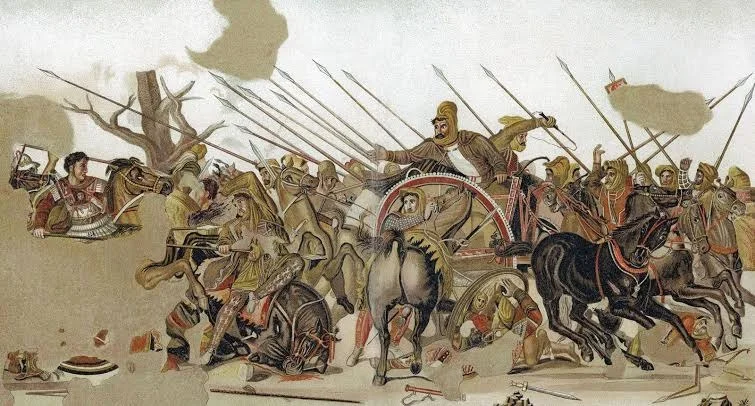
In 333 BCE, Alexander faced the Persian king Darius III at the Battle of Issus.
Although the Persian army was larger, Alexander used the battlefield effectively and achieved a major victory. Darius fled, leaving Alexander in control of the battlefield and allowing him to continue his advance.
Siege of Tyre and Conquest of Egypt
Alexander then moved along the eastern Mediterranean coast. One of his most difficult campaigns was the Siege of Tyre in 332 BCE.
Tyre was heavily fortified and located on an island. Alexander ordered the construction of a massive causeway to reach the city. After months of fighting, Tyre fell.
Later that year, Alexander entered Egypt, where he was welcomed by many Egyptians as a liberator from Persian rule. He founded the famous city of Alexandria, which later became an important center of learning and culture.
The Fall of the Persian Empire
Battle of Gaugamela
The decisive battle against Persia came in 331 BCE at the Battle of Gaugamela.
Darius III gathered a large army to stop Alexander. Despite being heavily outnumbered, Alexander used careful military tactics and launched a successful attack that caused the Persian army to collapse.
Darius escaped, but Alexander captured major Persian cities, including Babylon, Susa, and Persepolis.
The defeat at Gaugamela effectively ended the Achaemenid Persian Empire as a major political power.
Alexander’s Conquests in Central Asia
Alexander continued eastward into Bactria and Sogdia, where he faced strong local resistance.
Unlike his earlier battles, these campaigns became lengthy and difficult. Alexander adopted some Persian customs and formed alliances with local rulers.
He also married Roxana, the daughter of a local nobleman, as part of his efforts to strengthen relations between Macedonians and local populations.
Alexander the Great in India
In 327 BCE, Alexander began his campaign toward the Indian subcontinent. His army crossed the Hindu Kush and entered areas of modern-day Pakistan and northwestern India.
Battle of the Hydaspes
In 326 BCE, Alexander fought King Porus at the Battle of the Hydaspes River.
Porus’s army used war elephants, creating a serious challenge for Alexander’s soldiers. Despite the difficult battle, Alexander eventually defeated Porus.
According to ancient accounts, Alexander was impressed by Porus’s courage and allowed him to continue ruling his territory as an ally.
Why Did Alexander Stop?
After the Battle of the Hydaspes, Alexander wanted to continue farther into India. However, his soldiers had been campaigning for years and were exhausted.
At the Hyphasis River, his army refused to continue eastward. Alexander eventually accepted their decision and began the long journey back west.
This marked the eastern limit of his conquests.
The Death of Alexander the Great
Alexander returned to Babylon and began planning future military campaigns. However, he died in 323 BCE at only 32 years of age.
The exact cause of his death remains uncertain, although ancient sources describe a serious illness.
After his death, his generals fought for control of his empire. Eventually, it divided into several kingdoms, including the Seleucid Empire, Ptolemaic Egypt, and Macedonian territories.
Legacy of Alexander the Great
Alexander’s conquests had a lasting impact on world history. His campaigns spread Greek language, culture, art, architecture, and ideas across large parts of Asia and Egypt.
The cultural period that followed his conquests is known as the Hellenistic Age. During this period, Greek and Eastern cultures interacted and influenced one another.
Although Alexander’s empire did not remain united after his death, his military achievements and cultural influence continued for centuries.
Conclusion
The conquests of Alexander the Great transformed the ancient world. From his victories against the Persian Empire to his campaigns in Central Asia and India, Alexander built one of the largest empires of the ancient world in a remarkably short time.
His military genius, ambition, and cultural influence made him one of history’s most legendary rulers. More than two thousand years after his death, Alexander the Great remains one of the most studied figures in ancient history.