The Pyramids of Egypt are among the most extraordinary monuments ever built. For thousands of years, they have fascinated historians, archaeologists, and travelers. Moreover, these remarkable structures were built mainly as royal tombs. As a result, the pyramids provide valuable insight into the incredible engineering skills, religious beliefs, and organizational abilities of ancient Egyptian civilization.
Why Were the Egyptian Pyramids Built?
The pyramids were primarily built as tombs for Egyptian pharaohs and important members of the royal family.
Ancient Egyptians believed that life continued after death. They believed the pharaoh’s body needed to be preserved so that his spirit could continue its journey into the afterlife.
This religious belief led to the development of elaborate burial practices, including mummification and the construction of large tombs.The pyramid was therefore much more than a giant stone structure.
The Great Pyramid of Giza
The most famous pyramid is the Great Pyramid of Giza, built for Pharaoh Khufu around the 26th century BCE.
It was originally about 146.6 meters (481 feet) high, making it the tallest human-made structure in the world for thousands of years.
The Great Pyramid was constructed from millions of stone blocks. Its enormous size and precise design demonstrate the advanced planning and engineering abilities of ancient Egyptian builders.
It is also the only surviving Wonder of the Ancient World.
Who Built the Pyramids?
One of the most persistent myths is that the pyramids were built by thousands of slaves.
Modern archaeological evidence provides a more complicated picture.
Evidence from settlements near Giza suggests that large numbers of skilled workers, laborers, craftsmen, and other specialists participated in pyramid construction. Workers appear to have been organized into teams and supplied with food, shelter, and medical care.
This does not mean ancient Egypt had no slavery. Slavery existed in the ancient world, but the evidence does not support the idea that the Great Pyramid was simply built by an enormous army of chained slaves.
How Were the Pyramids Built?
The exact construction methods remain a subject of research and debate, but historians understand many parts of the process.
Workers transported limestone and other materials using boats, sledges, ramps, and organized labor teams.
The Nile River was particularly important because it provided a transportation route for moving heavy stone over long distances.
Builders also used simple but effective tools and carefully planned measurements to achieve remarkable precision.
The construction of the pyramids required not only physical labor but also mathematics, surveying, engineering, architecture, and detailed organization.
The Pyramids of Giza
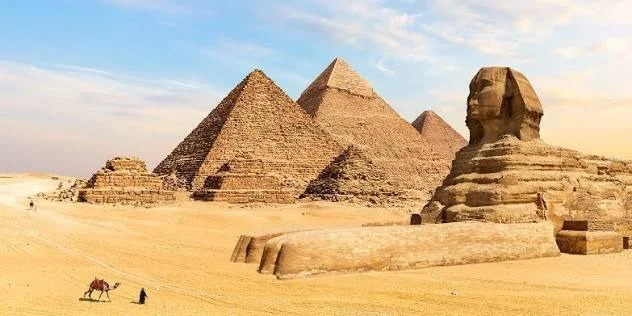
The Giza pyramid complex contains three major pyramids:
Great Pyramid of Khufu
The largest pyramid was built for Pharaoh Khufu. It was the tallest of the three and remains one of the greatest engineering achievements of the ancient world.
Pyramid of Khafre
The second pyramid was built for Khafre, Khufu’s successor. It appears taller in some photographs because it stands on higher ground and retains some of its original smooth limestone casing near the top.
Pyramid of Menkaure
The smallest of the three main pyramids was built for Menkaure. Although smaller, it formed an important part of the Giza complex.
The Sphinx and the Giza Complex
The pyramids were not isolated monuments. They formed part of a much larger complex containing temples, causeways, smaller pyramids, tombs, and other structures.
The famous Great Sphinx of Giza stands nearby. It has the body of a lion and a human head and is generally associated with the reign of Khafre.
Together, the pyramids and surrounding structures demonstrate the enormous resources and planning available to ancient Egyptian rulers.
Did Aliens Build the Pyramids?
One of the most popular modern theories claims that extraterrestrials helped build the pyramids.
There is no credible archaeological evidence supporting this idea.
The pyramids can be explained through the engineering knowledge, workforce, tools, transportation systems, and organizational abilities of ancient Egyptians.
Rather than making the pyramids less impressive, this evidence makes their achievement even more remarkable.
Why Are the Pyramids Still Important?
The pyramids provide valuable information about ancient Egyptian civilization. They reveal how religion, government, architecture, agriculture, mathematics, and labor were connected.
They also demonstrate the ability of the ancient Egyptian state to organize enormous construction projects over many years.
The pyramids remain symbols of one of the world’s earliest great civilizations.
Conclusion
The real history behind the pyramids of Egypt is even more fascinating than many popular myths suggest. These monumental structures were built as royal tombs and were closely connected to ancient Egyptian beliefs about death and the afterlife.
Their construction required extraordinary organization, engineering, transportation, and skilled labor.
More than 4,000 years later, the Pyramids of Giza remain among the world’s greatest archaeological wonders, offering a remarkable glimpse into the achievements of ancient Egypt.