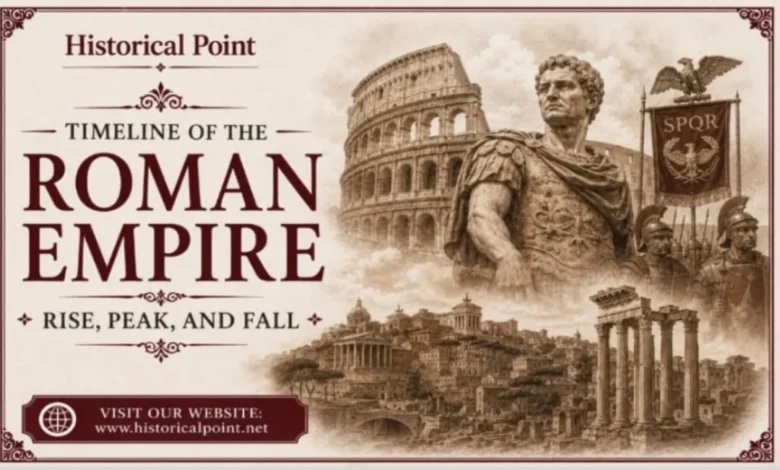
The Roman Empire was one of the most powerful and influential civilizations in world history. For centuries, Rome controlled vast territories across Europe, North Africa, and the Middle East. Its armies, laws, architecture, language, and political institutions shaped the world for generations.
But how did Rome rise from a small city to a massive empire, and why did it eventually fall? This timeline of the Roman Empire explores its rise, peak, decline, and final collapse.
753 BCE – Traditional Founding of Rome
According to Roman tradition, Rome was founded in 753 BCE by the legendary brothers Romulus and Remus.
Although the traditional story is partly legendary, archaeological evidence shows that settlements existed in the area long before Rome became a major power.
509 BCE – Roman Republic Begins
Around 509 BCE, the Roman monarchy was overthrown and the Roman Republic was established.
Rome developed a system of government involving elected officials, senators, and assemblies. Over the following centuries, Rome expanded across the Italian Peninsula.
264–146 BCE – Punic Wars
Rome’s greatest rival in the western Mediterranean was Carthage.
The three Punic Wars were fought between Rome and Carthage. The most famous Carthaginian commander was Hannibal, who famously crossed the Alps with his army and war elephants.
Ultimately, Rome defeated Carthage and became the dominant power in the western Mediterranean.
133–31 BCE – Crisis of the Roman Republic
As Rome became wealthier and expanded its territory, political conflicts intensified.
Powerful generals gained enormous influence, while civil wars weakened the Republic. Julius Caesar became one of Rome’s most powerful leaders.
In 44 BCE, Caesar was assassinated by a group of senators.
His death triggered another period of civil war.
27 BCE – Roman Empire Begins
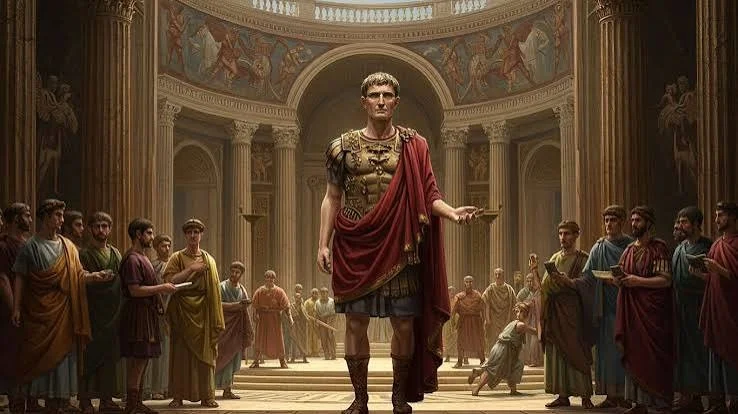
The Roman Empire is traditionally considered to have begun in 27 BCE, when Octavian became Augustus.
Augustus became Rome’s first emperor and established a more stable political system.
Under his rule, Rome entered a period of relative peace and prosperity that became known as the Pax Romana.
1st–2nd Centuries CE – Expansion and Peak
During the first and second centuries CE, the Roman Empire reached extraordinary levels of power.
Roman armies conquered and controlled territories stretching from Britain to North Africa and from Spain to the Middle East.
The empire developed extensive roads, cities, aqueducts, ports, and trade networks.
At its greatest extent, during the reign of Emperor Trajan, around 117 CE, Rome controlled one of the largest empires of the ancient world.
117 CE – Height of the Roman Empire
Emperor Trajan expanded Roman territory to its greatest extent.
His conquests included Dacia, an area roughly corresponding to modern Romania, and territories in the East.
The Roman Empire was enormous, wealthy, and militarily powerful.
180 CE – Death of Marcus Aurelius
The death of Marcus Aurelius in 180 CE is often viewed as an important turning point.
He was one of the last emperors associated with the period known as the Five Good Emperors.
After his death, political instability and military struggles became increasingly common.
3rd Century CE – Crisis of the Roman Empire
During the Third Century Crisis, Rome faced serious problems.
The empire experienced rapid changes of emperors, civil wars, economic difficulties, foreign invasions, and political instability.
However, the Roman Empire did not collapse during this period. Emperor Diocletian later introduced major reforms to stabilize the state.
284 CE – Reforms of Diocletian
Diocletian became emperor in 284 CE and reorganized the administration of the empire.
He introduced the Tetrarchy, dividing imperial authority among multiple rulers to make the enormous empire easier to govern.
These reforms temporarily strengthened Roman power.
313 CE – Christianity Gains Legal Recognition
In 313 CE, Emperor Constantine issued the Edict of Milan, which allowed Christians to practice their religion openly within the empire.
Constantine later became one of the most important rulers in Roman history and founded Constantinople as a major imperial capital.
395 CE – Permanent Division
After the death of Emperor Theodosius I in 395 CE, the Roman Empire was permanently divided into eastern and western administrations.
The Eastern Roman Empire survived for many centuries, while the Western Roman Empire became increasingly vulnerable.
410 CE – Sack of Rome
In 410 CE, the Visigoths under Alaric entered and sacked Rome.
The event shocked the Roman world and demonstrated the growing weakness of the Western Empire.
Nevertheless, Rome continued to exist for several more decades.
476 CE – Fall of the Western Roman Empire
In 476 CE, the Germanic military leader Odoacer deposed the young emperor Romulus Augustulus.
This event is traditionally considered the fall of the Western Roman Empire.
However, the Eastern Roman Empire, often called the Byzantine Empire, continued for almost another thousand years.
Why Did the Roman Empire Fall?
The fall of the Roman Empire was not caused by one event.
Several factors contributed, including:
- Political instability and civil wars
- Economic problems and inflation
- Military pressures and invasions
- Difficulty controlling a huge territory
- Political division between East and West
- Weakened central authority
Ultimately, these problems combined to weaken the Western Roman Empire.
Conclusion
The timeline of the Roman Empire is a story of extraordinary expansion, military power, political innovation, and eventual transformation.
From the traditional founding of Rome to the height of imperial power under Trajan and the fall of the Western Empire in 476 CE, Rome shaped the course of world history.
Even after the Western Empire disappeared, its laws, language, architecture, government, and culture continued to influence civilizations for centuries.

