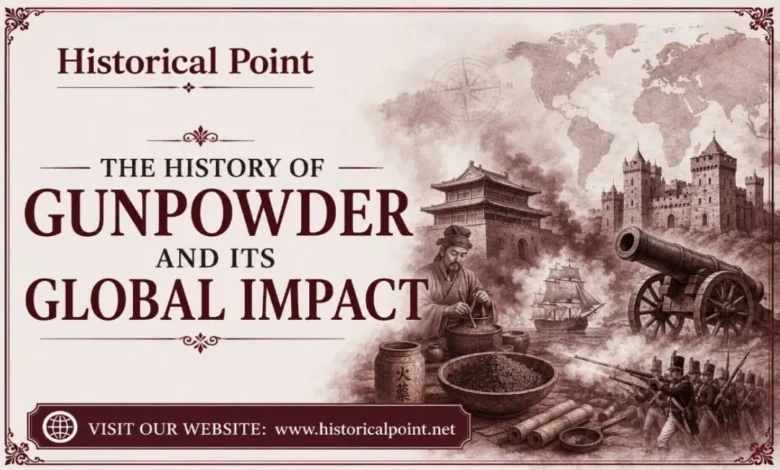
Gunpowder is one of the most important inventions in world history. Its discovery transformed warfare, changed the balance of political power, and influenced the development of empires across Asia, the Middle East, and Europe.
From its origins in ancient China to its widespread use in firearms and artillery, the history of gunpowder is a story of science, warfare, trade, and technological change.
The Origins of Gunpowder
Gunpowder was first developed in China, probably during the 9th century CE.
Chinese alchemists were searching for substances that could provide health, longevity, or even immortality. Instead, their experiments with different materials eventually produced a mixture that could burn rapidly and create an explosive effect.
The earliest gunpowder formulas contained saltpeter, sulfur, and charcoal.
At first, gunpowder was not primarily used as a weapon. It appeared in fireworks, signals, and other early applications.
Early Military Uses in China
Over time, Chinese inventors discovered that gunpowder could be used for warfare.
By the 10th and 11th centuries, Chinese armies were using weapons such as fire arrows, explosive devices, and early gunpowder bombs.
Later, more advanced weapons appeared, including early forms of firearms and cannons.
These inventions gradually changed military technology and demonstrated the enormous potential of gunpowder.
Gunpowder Spreads Across Asia and the Middle East
Gunpowder technology eventually spread beyond China.
Through trade, warfare, and cultural exchange, knowledge of gunpowder weapons reached Central Asia and the Islamic world.
Muslim empires and states adopted and developed gunpowder technology for military purposes.
By the late medieval period, firearms and artillery had become increasingly important in warfare across the Middle East and Asia.
Gunpowder Reaches Europe
Gunpowder knowledge reached Europe during the 13th and 14th centuries.
European armies gradually developed their own forms of cannons, handguns, and other firearms.
At first, these weapons were difficult to use and relatively unreliable. However, technological improvements gradually made firearms more effective.
Cannons became particularly important in sieges because they could damage fortified walls that had previously been extremely difficult to destroy.
The Gunpowder Empires
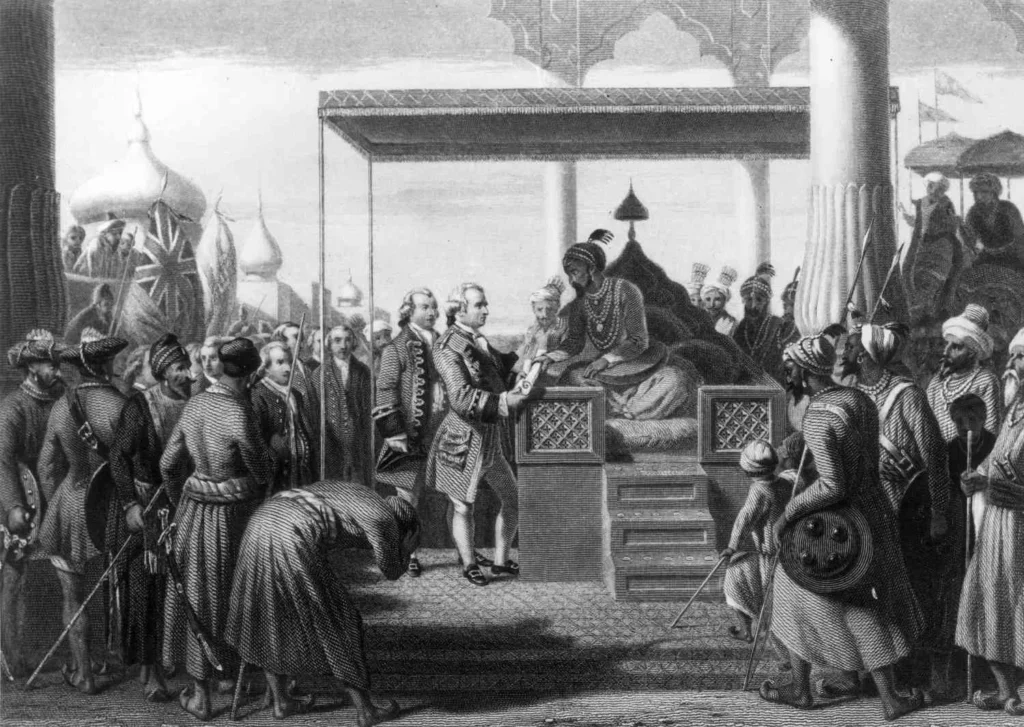
Gunpowder technology played a major role in the rise of several powerful empires.
Historians often refer to the Ottoman, Safavid, and Mughal Empires as the great Gunpowder Empires.
Ottoman Empire
The Ottoman Empire became famous for its powerful artillery.
One of the most famous examples was the Ottoman conquest of Constantinople in 1453, when large cannons were used against the city’s massive walls.
Safavid Empire
The Safavid Empire also adopted firearms and artillery as part of its military system.
Although firearms were not the only reason for Safavid power, gunpowder weapons became increasingly important in warfare and state organization.
Mughal Empire
The Mughal Empire used gunpowder weapons extensively during its expansion in South Asia.
In particular, Babur used field artillery and firearms during the First Battle of Panipat in 1526, helping him defeat a much larger army.
The victory played an important role in the establishment of Mughal rule in India.
How Gunpowder Changed Warfare
The spread of gunpowder weapons fundamentally changed military strategy.
Traditional armies had relied heavily on swords, bows, cavalry, and fortified defensive positions. Gradually, firearms and artillery became increasingly important.
Cannons could destroy walls, while firearms allowed infantry soldiers to challenge heavily armored opponents.
As a result, military training, fortifications, battlefield tactics, and the organization of armies all changed.
Gunpowder and the Rise of States
Gunpowder also influenced politics.
Powerful governments that could manufacture weapons, maintain professional armies, and finance artillery gained an advantage over smaller rivals.
Consequently, firearms helped central governments strengthen their authority and expand their territories.
Gunpowder therefore changed not only warfare but also the development of powerful states and empires.
The Global Impact of Gunpowder
The effects of gunpowder eventually reached almost every part of the world.
European expansion, Asian warfare, naval battles, and colonial conflicts were all influenced by firearms and artillery.
At the same time, advances in gunpowder technology encouraged further developments in metallurgy, engineering, chemistry, and military science.
The invention of gunpowder therefore had consequences far beyond the battlefield.
Conclusion
The history of gunpowder began with experiments by Chinese alchemists but eventually transformed societies across the world.
From early Chinese fire weapons to the cannons of the Ottoman Empire and firearms used by the Mughals, gunpowder changed how wars were fought and how states gained and maintained power.
Ultimately, gunpowder became one of the most influential technologies in human history, helping reshape warfare, politics, and the rise of powerful empires.

