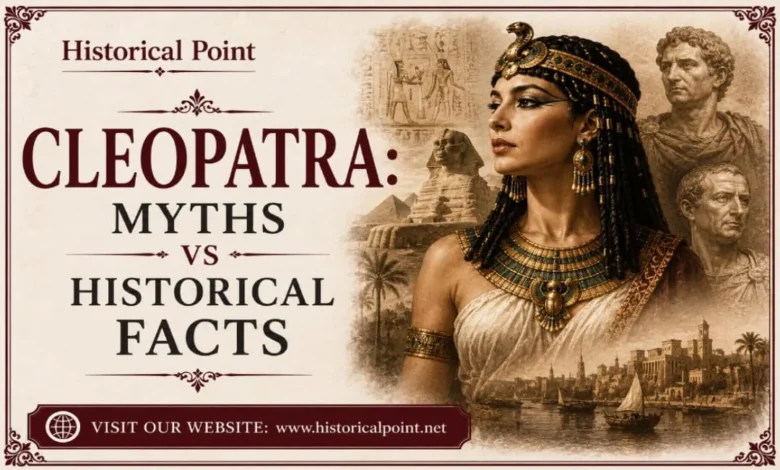
Cleopatra VII is one of the most famous women in ancient history. She has been portrayed in movies, books, paintings, and television as a beautiful and mysterious Egyptian queen. However, many popular stories about Cleopatra are based more on legend than historical evidence.
So, who was the real Cleopatra of Egypt? By separating myths from historical facts, we can better understand the remarkable ruler behind one of history’s most famous names.
Who Was Cleopatra?
Cleopatra VII Philopator was born in 69 BCE and became the last active ruler of the Ptolemaic Kingdom of Egypt.
Although she is often described simply as an Egyptian queen, Cleopatra belonged to the Ptolemaic dynasty, a Macedonian Greek royal family that had ruled Egypt since the death of Alexander the Great.
Interestingly, Cleopatra was one of the few members of her dynasty known to learn the Egyptian language. She was also highly educated and was reportedly familiar with several languages.
Myth 1: Cleopatra Was the Most Beautiful Woman in History
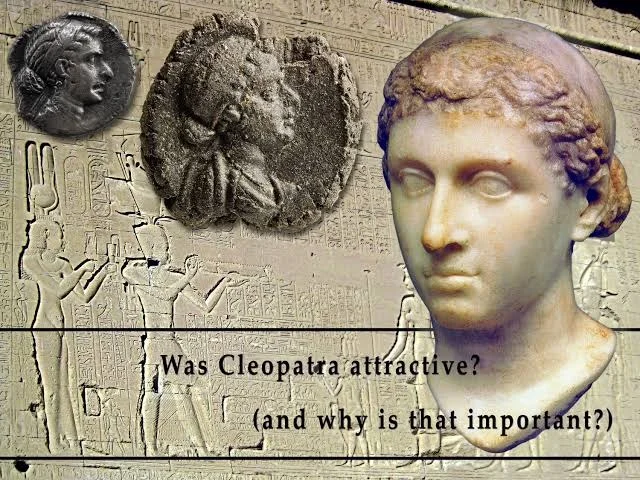
One of the most common stories about Cleopatra is that she was extraordinarily beautiful.
However, ancient sources suggest that her greatest attraction may have been her personality, intelligence, voice, and political abilities rather than physical beauty alone.
The Greek historian Plutarch, writing more than a century after Cleopatra’s death, suggested that her appearance was not necessarily extraordinary. Instead, he emphasized her charisma and conversation skills.
Therefore, the image of Cleopatra as simply the world’s most beautiful woman is largely a later interpretation.
Myth 2: Cleopatra Was Ethnically Egyptian
Cleopatra ruled Egypt, spoke the Egyptian language, and adopted aspects of Egyptian royal tradition.
Nevertheless, she was descended from the Macedonian Greek Ptolemaic dynasty.
Her family had ruled Egypt for almost three centuries before her birth.
This does not make her connection to Egypt any less important. Cleopatra strongly identified with Egyptian kingship and presented herself as a traditional Egyptian ruler.
Myth 3: Cleopatra Seduced Julius Caesar
Cleopatra’s relationship with Julius Caesar has often been presented as a romantic story in which she used her beauty to win his support.
The historical reality was more complicated.
Cleopatra was involved in a political struggle against her brother Ptolemy XIII. Caesar arrived in Egypt during the conflict, and Cleopatra formed an alliance with him.
Their relationship became personal, and Cleopatra later had a son named Caesarion, whom she claimed was Caesar’s child.
Thus, their relationship involved both political strategy and personal connection.
Myth 4: Cleopatra Was Only Interested in Romance
Cleopatra was far more than a romantic figure.
She was an experienced political leader who ruled Egypt during a period of intense conflict between Rome’s powerful politicians.
Moreover, Cleopatra worked to protect Egypt’s independence and strengthen her kingdom’s economy.
She understood the importance of Roman politics and formed alliances with powerful Roman leaders, first Caesar and later Mark Antony.
Myth 5: Cleopatra Died Because of a Snakebite
According to the famous story, Cleopatra committed suicide by allowing an Egyptian cobra, or asp, to bite her.
However, the exact cause of her death is uncertain.
Ancient sources describe the possibility of a snakebite, but they do not provide definitive evidence. Other theories suggest that she may have used poison delivered through another method.
Therefore, the famous snake story remains possible but cannot be confirmed with certainty.
Cleopatra and Mark Antony
After Caesar’s assassination in 44 BCE, Cleopatra became closely associated with Mark Antony, one of Rome’s most powerful leaders.
Together, they formed a political and personal alliance.
Their greatest opponent was Octavian, the future Roman emperor Augustus.
In 31 BCE, Octavian defeated the forces of Antony and Cleopatra at the Battle of Actium.
The defeat marked the beginning of the end for Cleopatra’s rule.
The Death of Cleopatra
In 30 BCE, Octavian’s forces entered Egypt.
Mark Antony died by suicide, and Cleopatra soon followed.
She died at approximately 39 years old.
After her death, Egypt became a Roman province, bringing the independent Ptolemaic Kingdom to an end.
The Real Legacy of Cleopatra
Cleopatra’s greatest historical importance lies in her role as a political ruler, not simply as a romantic or legendary figure.
She governed Egypt during one of the most turbulent periods of the ancient Mediterranean world. She used diplomacy, political alliances, economic policy, and royal traditions to defend her kingdom.
Ultimately, Cleopatra failed to preserve Egypt’s independence, but her story survived for more than two thousand years.
Conclusion
The real Cleopatra was far more complex than the legendary queen portrayed in popular culture.
She was a politically skilled ruler, an educated monarch, and a powerful figure who understood the dangerous politics of Rome.
While myths about her beauty, romances, and mysterious death continue to fascinate people, historical evidence reveals a much more interesting woman: a queen who fought to preserve her kingdom during the final years of ancient Egypt’s independence.